Tomi Adeyemi Is Not Talking Me Out of Children of Blood and Bone
OPINION | FILM | BOOKS | CELEBRITY
I bought Children of Blood and Bone because Tomi Adeyemi gave Black fantasy readers a world I wanted to enter. I still admire that achievement. But her public distancing from the film has not changed my plans: when Gina Prince-Bythewood’s adaptation opens on January 15, 2027, I intend to be there on day one.
Paramount’s ensemble includes Thuso Mbedu, Amandla Stenberg, Damson Idris, Tosin Cole, Viola Davis, Chiwetel Ejiofor, Cynthia Erivo, Regina King, Idris Elba, and Lashana Lynch. Adeyemi was announced as an executive producer and co-writer alongside Prince-Bythewood. This is a substantial gathering of Black talent, built around a Black author’s imagination.
I have to express my disappointment with how Adeyemi is discussing that shared undertaking. Public grievances accompanied by withheld explanations leave suspicion hanging over everyone else’s work. From my perspective, that is neither a fair nor a good-faith way to discuss an unreleased film. It risks undermining the very opportunity that readers, performers, and filmmakers have spent years supporting.
Public grievances need enough context to be useful
In her September 27 Guardian interview, Adeyemi said, “I won’t go into the specifics,” regarding her grievances about the film’s production.
That followed her July 29 TikTok statement, in which she described the adaptation as “the worst thing I have ever had to live through” and said she had left the set in distress. Those are serious descriptions of her experience. They still do not tell the audience which actions, decisions, or failures explain her condemnation.
Her feelings deserve to be taken seriously. Feelings alone, however, give readers too little information to judge the conduct of a production or the quality of a film. We cannot weigh an accusation that has no identifiable particulars, and we should not supply those particulars ourselves.
There is a qualification that fairness requires. Teen Vogue reported that Adeyemi cited contractual limits on earlier communication. She has also said that fans can still see the film. Describing her statements as an explicit boycott campaign would therefore misrepresent what she has said.
If a contract prevents a clear explanation, I understand why she cannot give one. What I find unhelpful, divisive, and unnecessary is repeatedly placing the grievance before the public while leaving the public unable to evaluate it. That can sound petty even when the hurt behind it is sincere.
She is entitled to distance herself. The cast and crew are also entitled to have their work assessed on something more concrete than an unresolved dispute. Being the author and an executive producer gives her perspective weight; it does not turn every implication into an established fact.
The (seemingly completely separate) Amandala Stenberg dispute makes that gap especially visible. Adeyemi shared an apparent February 28, 2025 message ending contact with the actor and forbidding her from further public use of her name. Vanity Fair subsequently reported, citing unnamed sources, that relations deteriorated after Stenberg’s casting-defense video. The principals did not confirm that account.
From outside, the public exchange looks like a damaged working relationship. Stenberg invoking Adeyemi while responding to backlash is a plausible point of conflict, given that reported sequence. It is not proof that every grievance is a personality clash, or that Stenberg caused whatever happened on set. A fragment of a private conversation cannot settle that question.
Nor can anyone yet establish that Adeyemi’s comments have cost the movie ticket sales. My criticism is that they risk sabotaging its reception before release. Intent and eventual box-office impact remain separate questions. In her interview with Good Morning America, Adeyemi discussed, in reference to her leaving the movie set, “The fact is there were things that happened behind the scenes that put me at Jeopardy; it was a lot bigger than a creative… misalignment,” but goes on to say the book and movies came from the beyond and are something “Bigger than me”. Implying that her grievances, whatever they are, aren’t the end a show stopper. Though again these sentiments fuel further speculation. Her vague comments about Amandala have also led to much speculation about the underlying issue, reigniting online discourse about her skin tone.
GMA 09/29/20206 Tomi Adeyemi interview at 01:02:25
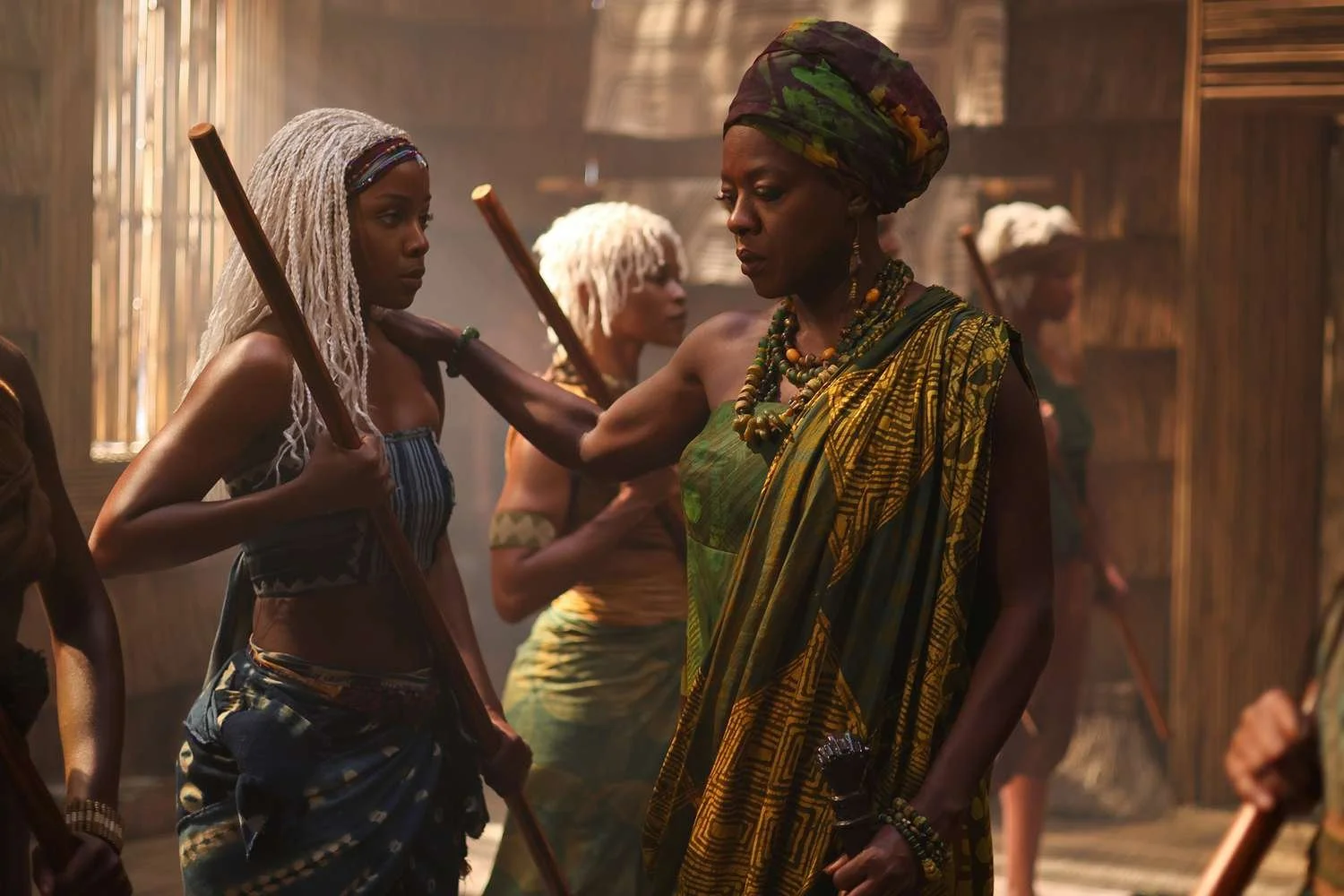
Amari is described in relation to her mother
The casting argument needs the same discipline. The Guardian’s casting summary even uses “dark copper skin.” Except that’s not the wording used in the book to describe the character.
“Mother places a cold hand on my shoulder, fingers light against my darker copper skin.”
The word is “darker,” and the comparison is explicit. The queen’s fingers are light comparatively to Amari’s skin, which is darker. But darker is relative in that situation. Just like Amari is light relative to Zelle. Cold further describes the hand’s touch. Earlier in the scene, the queen is described as having “soft copper complexion.” These are relative descriptions, not a precise shade chart. Yes, Amari is darker than her mother; they are both imagined by Adeyemi as copper colored. That does not automatically make her dark-skinned in every real-world context, much less establish that Stenberg cannot plausibly embody her. Turning a comparative description into an absolute casting requirement adds certainty the passage does not provide.
Copper itself illustrates the problem. Polished copper is reddish-orange, while tarnish darkens it. I have copper mugs in my cabinet that look lighter than Stenberg. That observation does not make my kitchen a casting department. It does remind me that the word copper can evoke different appearances, depending on the surface and the light.
Adeyemi’s own early imaginings make the categorical objection harder to sustain. In Cosmopolitan on March 7, 2018 a mere months after the book’s release, when asked who she would cast, she named Zendaya with John Boyega and Tessa Thompson with Michael B. Jordan as Amari and Tzain. At that time, it was clear how she imagined Amari’s complexion.
Those were playful dream pairings, not formal casting instructions or an endorsement of Stenberg years later. Still, both women she imagined as Amari are readily recognizable as lighter-complexioned Black actors. That is a meaningful counterpoint to the assertion that a lighter-complexioned Amari inherently violates her conception of the character.
On this evidence, I find Stenberg a defensible fit. Readers can reasonably prefer another actor or imagine a deeper complexion. They should not present that preference as the only interpretation the text permits.

The royal household complicates the colorism argument
A claim commonly argued online is that Amari is the darkest person in her family, which is also poorly supported. The same chapter describes King Saran’s skin as “mahogany.” and Inan is described as sharing Amari’s copper complexion. Those descriptions give no sound basis for making Amari the family’s uniquely darkest member. That is quite obviously her father.
At the luncheon from chapter 1, Nehanda pressures Amari to adopt Samara’s beauty routine. Samara is Oloye Ronke’s daughter, presented as a prospective match for Inan. Her newly lightened appearance wins the queen’s approval; Amari recalls painful cosmetic treatments and being powdered before lunch.
The scene makes colorism real without requiring Amari to be darker than every relative. The complexion talk and immediate pressure come through women policing the young Amari’s appearance, while a mahogany-skinned man occupies the throne. That is a revealing contrast in who from the story is expected to satisfy that particular beauty standard.
I would not extend it into a claim that male characters are immune to colorism. The passage also describes nobles suppressing signs of maji ancestry. The narrower point is strong enough: Amari’s treatment is gendered and tied to status, ancestry, and marriageability. Her mother can discriminate against her even when her father has a deeper complexion.
Regina King as Nehanda presents a clearer complication for literal shade matching. King’s familiar public appearance is deeper in complexion than Stenberg’s, so their casting challenges the mother-daughter contrast in that particular passage. If exact complexion matching were the sole test, the queen would be the more obvious mismatch.
I am comfortable with that tradeoff. Why would I pass on an Oscar winner and four-time Emmy winner solely to preserve a relative difference in skin tone? Regina brings a record of accomplishment that matters to my interest in this film.
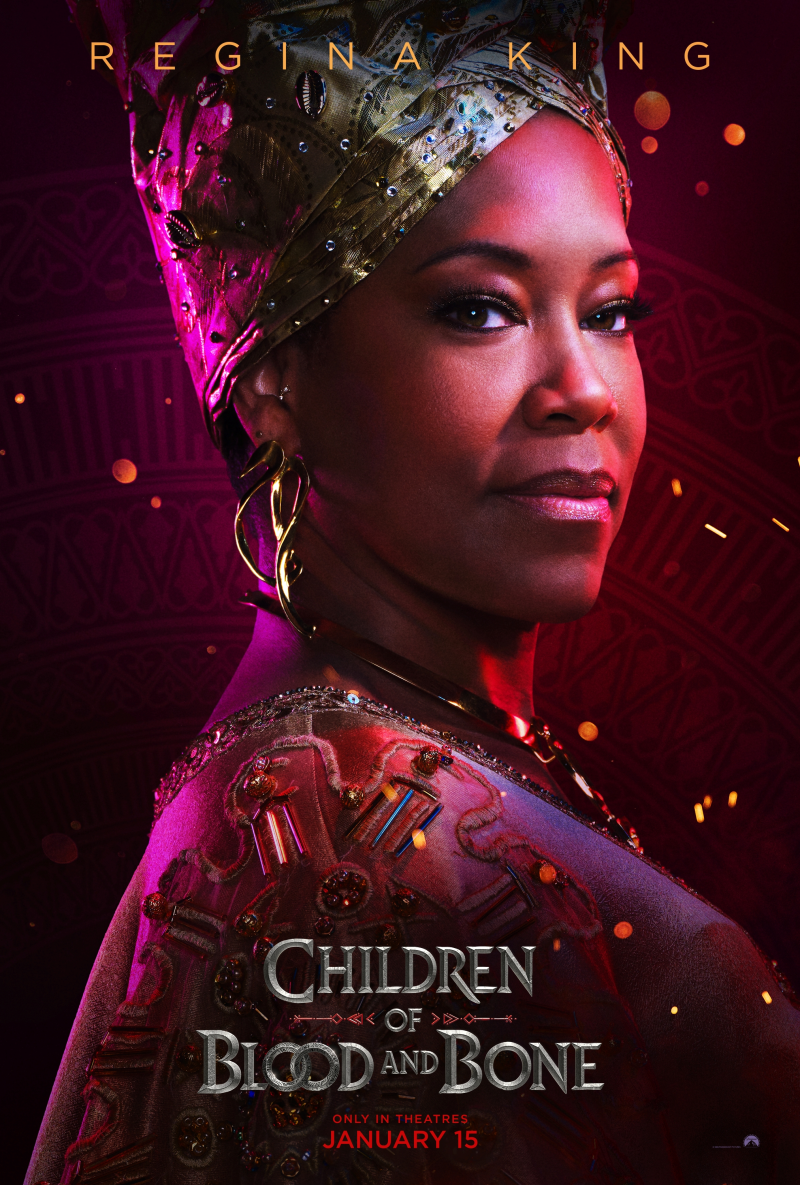
A darker Nehanda could also make the character’s prejudice more pointed. She could enforce a standard she does not meet herself, showing how people internalize a hierarchy and impose it on their children. It’s not like that isn’t something we’ve all seen before.
The filmmakers would need to adapt the relevant dialogue intelligently. The book’s visual comparison could not be reproduced unchanged and expected to mean the same thing if the screen presentation reverses it. But the humiliation, status anxiety, and pressure to lighten could still be dramatized. Colorism can survive that change, and its hypocrisy could become more visible.
Stenberg keeps becoming the argument
At this point, I’m kind of feeling sorry for Stenberg, who has repeatedly faced public disputes involving race or complexion. Her casting in The Hate U Give generated criticism about a lighter-skinned actor playing Starr. Her Instagram response recorded her acknowledgment that darker-skinned women faced colorism she did not experience. Her casting in The Acolyte brought racist and homophobic hostility, which she also addressed publicly.
Those backlashes have different causes. Criticism of Hollywood’s preference for lighter-skinned Black women deserves serious discussion. Racist hostility toward Black participation in Star Wars is a different matter. Treating every critic as a racist would be as careless as pretending all the hostility was a thoughtful argument about casting.
Yet the cumulative spectacle is exhausting: one would think from social media outrage no one wants someone her color in anything.
I want more opportunities for darker-skinned Black women. I also want Stenberg to be able to play a character without every production becoming a referendum on whether she is too Black for one audience and insufficiently Black for another. There’s so much dark skinned representation in this movie!
A useful casting critique should identify what the film changes and why that change matters. With Amari, it should begin with the actual comparative wording, address the character’s treatment, and consider the other casting choices. Repeating an inaccurate description and directing the resulting anger at one actor does little for that conversation.
I want this film to help make more Black fantasy possible
I supported Adeyemi by purchasing her book. Supporting this Black cast and Black director is consistent with that decision. I do not see loyalty to an author as an obligation to inherit her unresolved conflicts or reject other artists’ work before I can assess it.
I want Children of Blood and Bone to succeed because I want Hollywood to invest in more Black fantasy. My hope is that a successful production will give decision-makers another reason to back ambitious screen adaptations of writers such as N. K. Jemisin and Nnedi Okorafor. Their imaginative work deserves more routes to audiences.
That is a hope, not a promise that one box-office result will determine another author’s future. Black artists should not have to carry an entire genre’s commercial prospects on a single film. Still, audiences choosing to show up can demonstrate demand, and I want to contribute to that.
As a huge fan of Adeyemi, I am disappointed that the conversation she is helping shape now revolves around public grievances without enough public explanation. If fuller facts emerge, I will consider them. For now, her personal decision to stay away does not give me a sufficient reason to follow her example.
This accomplished cast and crew have earned my interest. The finished film will have to earn my praise. I plan to show up on day one, support this collection of Black excellence, and judge Children of Blood and Bone for myself. 👓